Tag: Artificial Intelligence

Improving Alpha: How Institutional Investors Make Sense of Platformocracy in Investing

Improving Alpha: How Institutional Investors Make Sense of Platformocracy in Investing

As more institutional investors increasingly rely on massive amounts of data and consolidated software ecosystems, the term Platformocracy is finding its way into everyday usage. The term is defined as how major technology companies function as unelected governments, leveraging their networks to unilaterally dictate free speech, rules around online privacy, and more, all without impartial oversight. Given this landscape, how can institutional investors navigate allocation strategies to avoid risks in their investments and keep their investment strategies private?

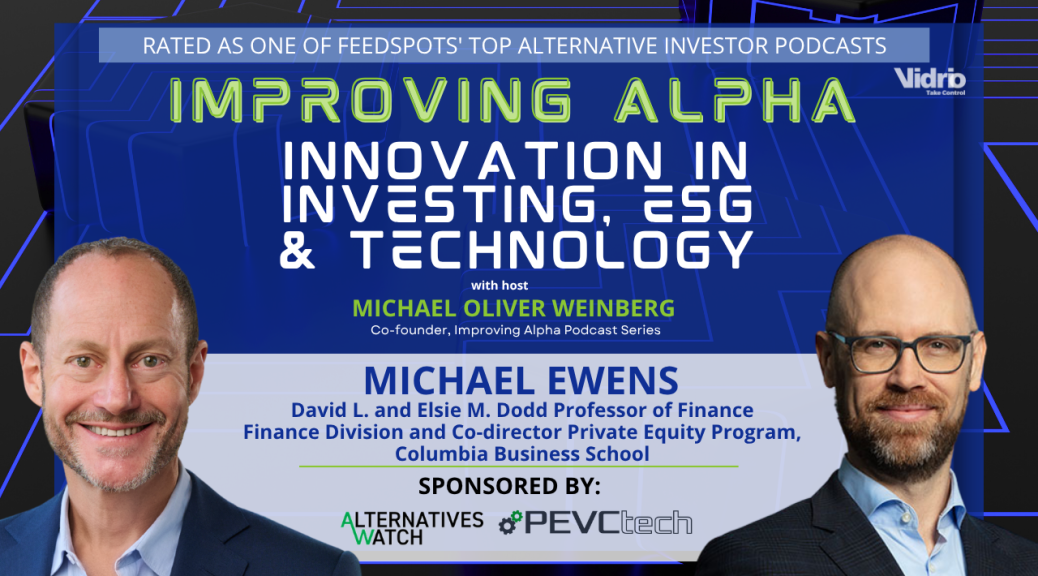
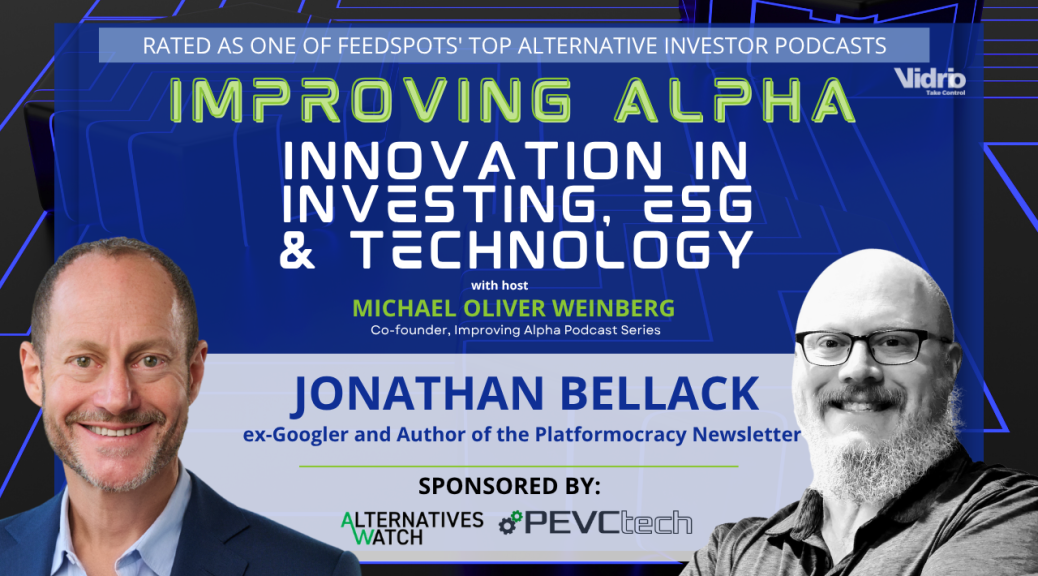
In our latest episode of the Improving Alpha podcast series, host Michael Oliver Weinberg speaks with Jonathan Bellack, ex-Googler and Author of the Platformocracy newsletter, to discuss his insights on corporate controls tied to digital communities, privacy concerns on data usage, AI-driven market manipulation, and more.

Key takeaways include:

  • How did Jonathan’s career evolve from building and growing sustainable businesses to working in digital counter-abuse and safety technology?
  • Can technology companies really build a transparent democratic process for their online communities, or does the concept of implicit feudalism win the day?
  • The concept of exit signals, and how organizations pay closer attention to them before it’s too late.
  • What is the idea of surveillance capitalism, and the impact on digital privacy?
  • How should asset owners look at information integrity, and can it be considered a systemic risk in today’s digital environment?
  • What are Jonathan’s thoughts on ethical investing and how it relates to fiduciary duties?
  • Will AI-driven governance make platforms more stable for investors?
  • And more.

Connect with Jonathan Bellack:

Connect with Michael Oliver Weinberg: 

About Our Guest:

Jonathan Bellack has spent more than 30 years working across the evolution of the internet economy, beginning with dot-com startups before earning his MBA and helping lead a SaaS turnaround that was later acquired by Google for $3.1 billion. During his 15 years at Google, he served as a senior product management leader, helping build billion-dollar advertising businesses while also leading efforts focused on online safety and counter-abuse technologies that impacted billions of users worldwide. After leaving Google in 2023, Jonathan spent a year building the Applied Social Media Lab at Harvard’s Berkman Klein Center for Internet and Society.

Today, Jonathan focuses on helping product-driven organizations and leaders solve problems and deliver meaningful outcomes. He also publishes Platformocracy, a weekly newsletter exploring participatory governance and accountability in online communities.

Outside of work, Jonathan is a husband and father of two sons with a passion for grilling, whiskey, and all things nerd culture. He serves on the boards of Montclair Local Nonprofit News and New Jersey 11th for Change, as well as the Trust & Safety Advisory Group at the Institute for Security and Technology. He also guest lectures on product leadership at Columbia and UCLA business schools, and recently added “dog owner” to the list.

The information covered and posted represents the views and opinions of the guest and does not necessarily represent the views or opinions of Vidrio Financial, and/or our host, Michael Oliver Weinberg. The Content has been made available for informational and educational purposes only. The Content is not intended to be a substitute for professional investing advice. Always seek the advice of your financial advisor or other qualified financial service provider with any questions you may have regarding your investment planning.

The release date may not correspond to the recording date.
Improving Alpha: Chris Wiggins Exploring and Exploiting the Value of Artificial Intelligence

Improving Alpha: Chris Wiggins Exploring and Exploiting the Value of Artificial Intelligence

Allocators face a barrage of ideas and debates around the use of artificial intelligence and large language models, better known as LLMs. How can huge amounts of investor data be transformed and enriched to solve challenges in asset allocations and improve an investment team’s strategy? Better yet, have we accumulated enough ‘scar tissue’ in artificial intelligence to understand what AI gets wrong and is easily corrected, versus what is instantaneously correct and becomes actionable intelligence?

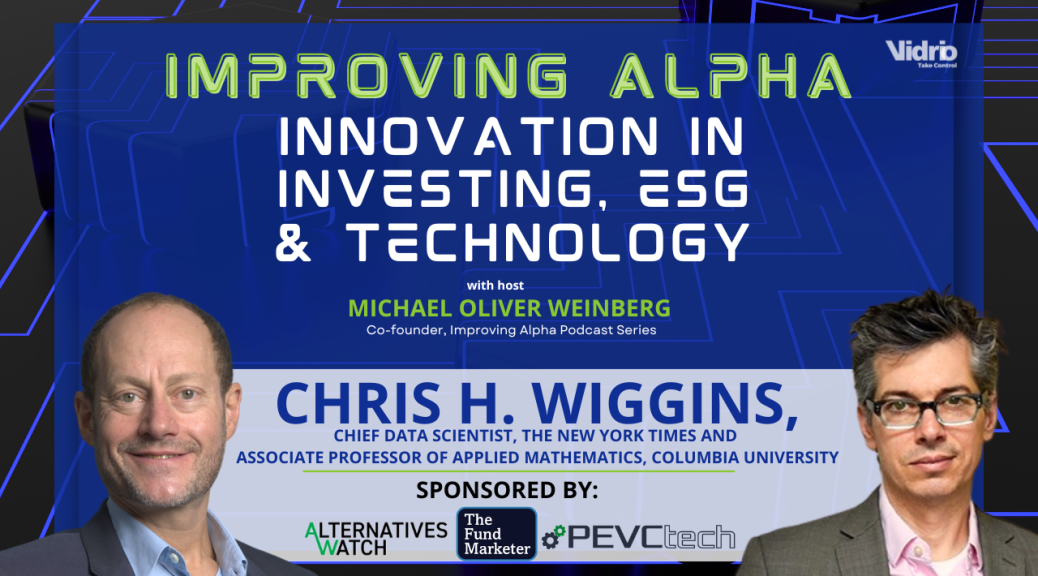
In our latest episode of the Improving Alpha podcast, host Michael Oliver Weinberg sits down with Chris H. Wiggins, Chief Data Scientist, The New York Times and Associate Professor of Applied Mathematics, Columbia University, to dive deeper into the fundamentals of data science, dashboarding, and KPIs.

Further highlights from Michael’s discussion with Chris include: 

  • in a crowded field of AI adopters, where does the advantage lie today? With the new disruptors in a given industry or the incumbents?
  • what are the forces behind data science and how does the framework of descriptive data sets, predictive models, and prescriptive solutions help inform those wishing to leverage AI or LLMs?
  • when adding a data scientist to an investment team, what should the hiring organization be on the lookout for, before extending an offer?
  • the ‘shocking’ acceptance of the AI problem.
  • AI’s impact on the labor force in the next few years.
  • from an investment play is it better to buy into the AI craze and the deep learning networks, or is the real ‘gold rush’ centered around the requirements necessary to expand artificial intelligence usage via data centers, people who train the models, and the data contained in these models? 
  • Listen now to find out more. 

Resources:

Connect with Chris Wiggins:

Connect with Michael Oliver Weinberg: 

About Our Guest:

Chris Wiggins is an associate professor of applied mathematics at Columbia University and the Chief Data Scientist at the New York Times. At Columbia he is a founding member of the Department of Systems Biology, the executive committee of the Data Science Institute (http://datascience.columbia.edu/), and the Institute’s education and entrepreneurship committees. He is also an affiliate of Columbia’s Department of Statistics and a founding member of Columbia’s Center for Computational Biology and Bioinformatics (C2B2). He is a co-founder and co-organizer of hackNY (http://hackNY.org), a nonprofit that since 2010 has organized once-a-semester student hackathons and the hackNY Fellows Program, a structured summer internship at NYC startups. Prior to joining the faculty at Columbia he was a Courant Instructor at NYU (1998-2001) and earned his PhD at Princeton University (1993-1998) in theoretical physics. In 2014 he was elected Fellow of the American Physical Society and is a recipient of Columbia’s Avanessians Diversity Award.

The information covered and posted represents the views and opinions of the guest and does not necessarily represent the views or opinions of Vidrio Financial, and/or our host, Michael Oliver Weinberg. The Content has been made available for informational and educational purposes only. The Content is not intended to be a substitute for professional investing advice. Always seek the advice of your financial advisor or other qualified financial service provider with any questions you may have regarding your investment planning.

The release date may not correspond to the recording date.
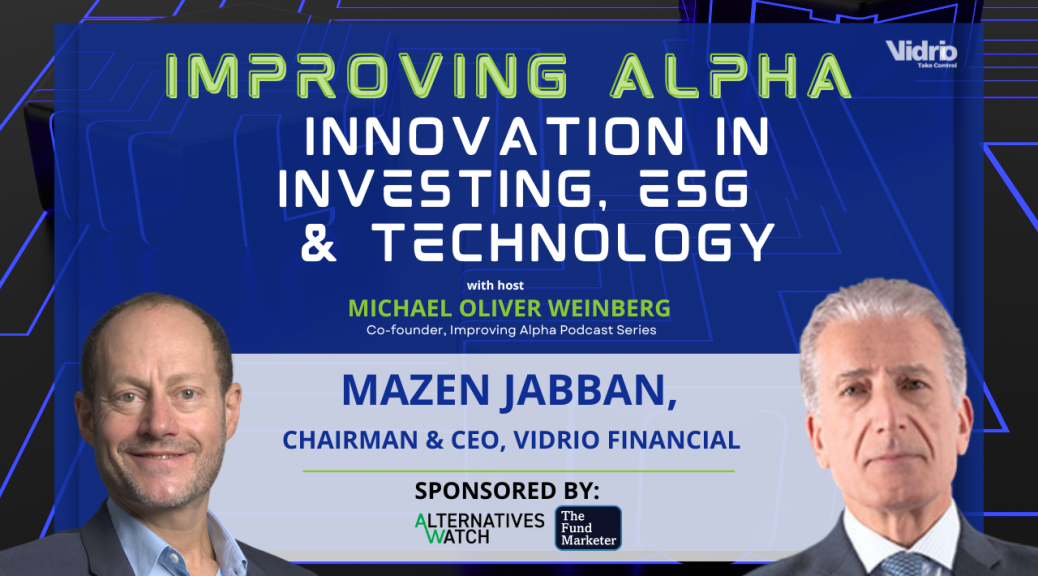
Improving Alpha: Mazen Jabban on the Dangers of Delegating Away Allocator Innovation

Improving Alpha: Mazen Jabban on the Dangers of Delegating Away Allocator Innovation

Navigating the world of technology innovations as a chief investment officer or portfolio manager is akin to a thrilling game of high-stakes poker or a graceful tango. Your success hinges on your ability to not just welcome incoming innovations but also effectively implement them, enhancing data transparency, boosting portfolio returns, and more.

In this episode of the Improving Alpha podcast, Michael Oliver Weinberg is joined by Mazen Jabban, Chairman & CEO, Vidrio Financial. Mazen details his journey on what led him to create Vidrio Financial, and how allocators should look at the paradigm shifts occurring in innovations across the investment community. 

Mazen further highlights: 

  • how the revolutionary impact of artificial intelligence and large language models (LLM) could shape the landscape for institutional investors.
  • the continued significance of transparency within the GP-LP relationship and the transformative influence of technology on these dialogues.
  • the investment for allocators to dedicate resources towards purchasing or constructing infrastructure to enhance data management practices..
  • how can institutional investors successfully implement a comprehensive portfolio strategy when faced with segmented teams spanning private equity, real estate, and hedge funds, each with their unique risk, data, and performance methodologies.
  • insights on private credit and the transformative potential of technology advancements for this asset class.
  • And more.

Resources:

Connect with Mazen Jabban:

Mazen Jabban is the Founder, Chairman, and CEO of Vidrio Financial, a New York-based company that provides institutional investors managing alternative investments with investment management solutions on a single platform. He is responsible for setting strategic direction and the firm’s product development roadmap. 

As an entrepreneur at heart, with years of experience in investment strategies, IT systems, management consulting, real estate development, and investment he is always looking for new ways to grow.

Connect with Michael Oliver Weinberg: 

The information covered and posted represents the views and opinions of the guest and does not necessarily represent the views or opinions of Vidrio Financial, and/or our host, Michael Oliver Weinberg. The Content has been made available for informational and educational purposes only. The Content is not intended to be a substitute for professional investing advice. Always seek the advice of your financial advisor or other qualified financial service provider with any questions you may have regarding your investment planning.

The release date may not correspond to the recording date.
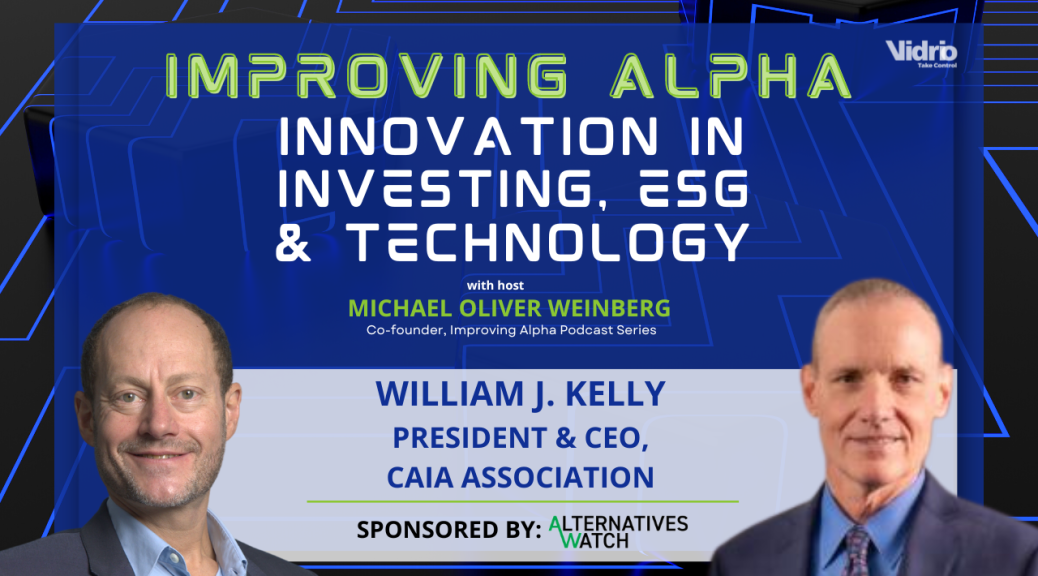
Improving Alpha: William J. Kelly, CAIA on disrupting data transparency in the institutional markets

Improving Alpha: William J. Kelly, CAIA on disrupting data transparency in the institutional markets

As institutional investments become increasingly intricate, it is crucial to bring transparency (and perhaps even enlightenment) to both GPs and LPs. Large data sets and the scale of innovative technology shows no signs of decelerating for those seeking alpha. Serving as a cautionary tale for this installment of Improving Alpha, a famous quote by renowned British Economist Ronald H. Coase once said, “ if you torture the data long enough, it will confess to anything”.

Join Michael Oliver Weinberg as he sits down with William (Bill) J. Kelly, CAIA, President & CEO of the CAIA Association, in this captivating episode. In just :40 minutes, Bill shares his insightful perspectives on the ever-increasing regulation of private markets and the importance of data transparency. Dive into the fascinating world of AI and large language models, and explore the latest trends in ESG. Don’t forget to click on the audio play button at the top of this page to uncover even more valuable insights.

Further highlights cover

  • a brief overview of CAIA and FDP, explaining their origins and their roles in the alternative investments industry
  • the critical importance of being able to upskill and cross-skill the cast of characters that define the investment process, and how the process has changed over the last 10 years.
  • will artificial intelligence ever be able to build a comprehensive mosaic around cash flow, manager letters, and more.
  • learning what’s on the minds of larger allocators when it comes to increasing regulation by the SEC, and would real opinions be presented better with a ‘truth serum’ cocktail on data transparency.
  • the huge potential of doing well at one pillar of ESG, while simultaneously nuking another pillar. 
  • And more!

Connect with Michael Oliver Weinberg: 

Connect with William (Bill) Kelly:

About William (Bill) Kelly:

William (Bill) J. Kelly, CAIA is the President & CEO of the CAIA Association. Bill has been a frequent industry speaker, writer, and commentator on alternative investment topics around the world since taking the leadership role at the CAIA Association in January 2014. Previously, Bill was the CEO of Boston Partners and one of seven founding partners of the predecessor firm, Boston Partners Asset Management which, prior to a majority interest being sold to Robeco Group in Rotterdam in 2002, was an employee-owned firm. Bill’s career in the institutional asset management space spans over 30 years where he gained extensive managerial experience through successive CFO, COO, and CEO roles. In addition to his current role, Bill is a tireless advocate for shareholder protection and investor education and is currently the Chairman and lead independent director for the Boston Partners Trust Company. He has previously served as an independent director and audit committee chair for ’40 Act Mutual Funds and other financial services firms. He is also currently an Advisory Board Member of the Certified Investment Fund Director Institute which strives to bring the highest levels of professionalism and governance to independent fund directors around the world. A member of the board of the CAIA Association, Bill also represents CAIA in similar capacities via their global partnerships with other associations and global regulators. Bill began his career as an accountant with PwC and is a designated Audit Committee Financial Expert in accordance with SEC rules. 

The information covered and posted represents the views and opinions of the guest and does not necessarily represent the views or opinions of Vidrio Financial, and/or our host, Michael Oliver Weinberg. The Content has been made available for informational and educational purposes only. The Content is not intended to be a substitute for professional investing advice. Always seek the advice of your financial advisor or other qualified financial service provider with any questions you may have regarding your investment planning.

The release date may not correspond to the recording date.