Tag: Robotics

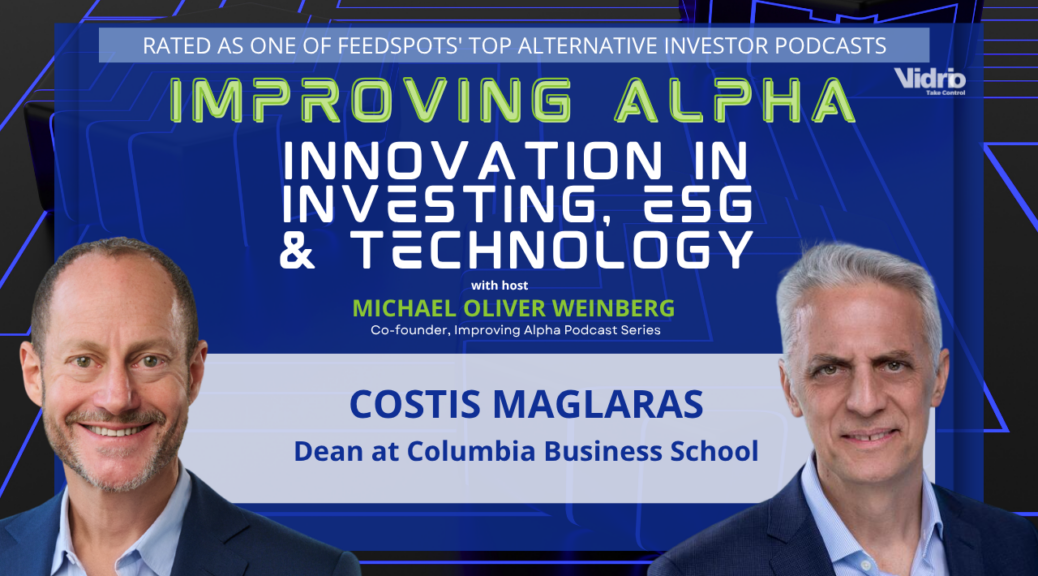
Improving Alpha: How the Columbia Business School is Approaching Transformative AI in Institutional Investing

Improving Alpha: How the Columbia Business School is Approaching Transformative AI in Institutional Investing

Technology is driving innovation across all industry themes today. Many in finance and institutional investing believe artificial intelligence will be a force of dramatic change in the near future. The question becomes how can universities continue to be well-positioned for this technology expansion and growth while continuing to train students to prepare for the new world? More importantly, how can institutional investors that are currently navigating the markets leverage academic research to improve alpha and optimize their own organizations?

One university that is going all-in on understanding this massive technology wave is Columbia, and their business school. The Dean of the Columbia Business School, Costis Maglaras, joins the latest Improving Alpha episode to discuss his observations and approach to preparing students for the future and what technology transformation looks like across finance.

Additional key takeaways from this podcast include:

  • Why is AI becoming such a drastic source of change for Columbia’s students and the industry as a whole?
  • How many layers are there to curriculum innovation at Columbia, and what is so attractive about their AI tool for case discussions that it’s being piloted in 25 business schools across the country?
  • What can the industry do better in leveraging academic research and modeling to improve alpha and portfolio performance returns? (For followers of the Improving Alpha podcast, you should also catch Simon Mayer, Assistant Professor of Finance, Carnegie Mellon University, for his thoughts on that as well).
  •  What is the difference between stationary and non-stationary LLM/neural net analysis? How do environmental variables like geopolitics, unpredictable changes in economic conditions, and more factor into any analysis?
  • From a university perspective, is coding becoming less important as students’ knowledge of agentic AI and Claude improves? How is Columbia approaching vibe coding?
  • What will the institutional response be in digesting this wave of new technology, and how much change will happen to their financial products, services, and processes?
  • Against a backdrop of Jamie Dimon soundbites, how does Costis think the labor force will be impacted by the use of AI?
  • And more.

Connect with Costis Maglaras:

Connect with Michael Oliver Weinberg: 

About Our Guest:

Costis Maglaras is the 16th Dean of Columbia Business School and the David and Lyn Silfen Professor of Business at Columbia University. His work spans applied mathematics, economics, financial engineering, artificial intelligence, market structure, and algorithmic decision-making. He also brings experience in financial technology and asset management, including co-founding Mismi Inc., a quantitative trading and transaction analytics firm. 

The information covered and posted represents the views and opinions of the guest and does not necessarily represent the views or opinions of Vidrio Financial, and/or our host, Michael Oliver Weinberg. The Content has been made available for informational and educational purposes only. The Content is not intended to be a substitute for professional investing advice. Always seek the advice of your financial advisor or other qualified financial service provider with any questions you may have regarding your investment planning.

The release date may not correspond to the recording date.
Improving Alpha: Global AI Investment & ROI: Navigating US, China, and Asian Markets

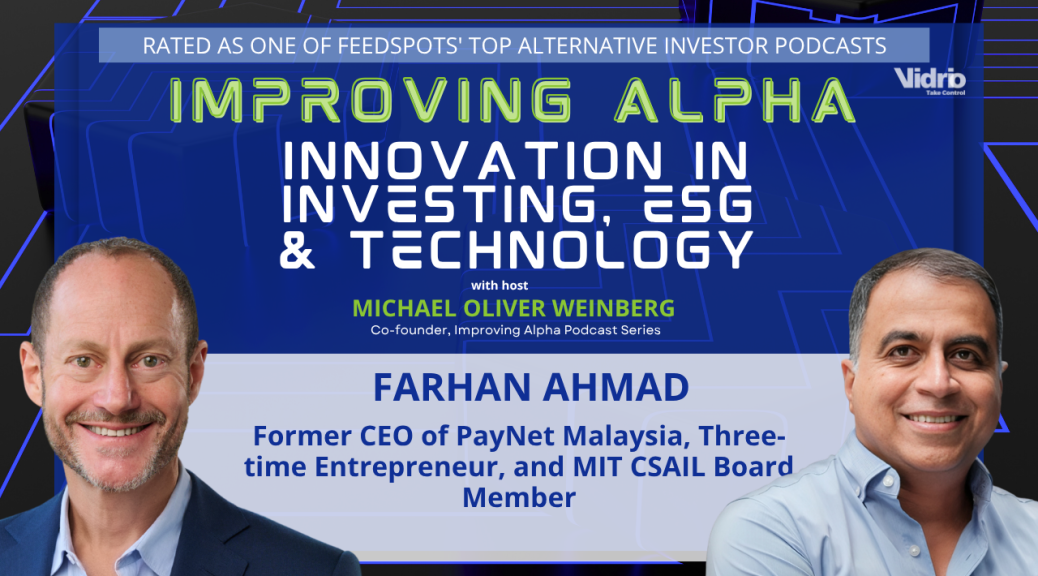
Improving Alpha: Global AI Investment & ROI: Navigating US, China, and Asian Markets

How do the United States and Asia approach the expansion of artificial intelligence for the future? On one side of the world, you have frontier model development requiring massive compute and content ingestion, while the other side is looking at their internal strengths and figuring out where AI can have the greatest impact. As investors, how can we figure out a true ROI to place our bets on across regions of the world?

In this latest episode of the Improving Alpha podcast, host Michael Oliver Weinberg is joined by Farhan Ahmad, Former CEO of PayNet Malaysia, Three Time Entrepreneur, and MIT CSAIL Board Member, to discuss the nuanced approach of Asian AI model development, the concept of interoperability vs isolated development, ongoing AI adoption and improved social outcomes,  and how the United States and Europe plan to stay engaged in this innovation.

Key highlights include:

  • How is AI impacting small- to medium-sized businesses, and is there a valuable investor story to uncover?
  • Can the US effectively compete with China when it comes to robotics, manufacturing, and autonomous vehicles? Will a new age of US manufacturing come into play if we can lower labor costs across the country?
  • What sort of impact does the Chinese government have in mandating the development and rollout of AI across schools, banks, and other businesses? Is there a comparable national-level strategy for that rollout in the US?
  • Does a national security threat exist in Chinese exports to the US that have embedded AI components?
  • How does Malaysia’s ILMU differ from foundation models being deployed in the US and mainland China? Will smaller models be able to catch up with larger LLM models through distillation, and how do real world examples figure into these equations?
  • How can the lessons at PayNet on shared rails and interoperability be applied to cross-border cooperation, especially when looking at Singapore and Vietnam?
  • And more.

Resources:

Connect with Farhan Ahmad:

Connect with Michael Oliver Weinberg: 

About Our Guest:

Farhan Ahmad is a three-time entrepreneur, technology executive, and former CEO of PayNet Malaysia, the country’s national payments network. Throughout his career, he has founded and successfully exited three technology companies and held leadership roles across banking, financial technology, and digital payments in both the United States and Europe. While leading PayNet, he helped expand one of the world’s most advanced real-time payment networks, significantly increasing its scale and strengthening cross-border payment interoperability across Asia. Farhan also serves on the board of the MIT Computer Science and Artificial Intelligence Laboratory (CSAIL), where he contributes to discussions at the intersection of artificial intelligence, technology, and innovation. His work focuses on AI adoption, financial infrastructure, digital transformation, and the practical application of emerging technologies to solve real-world challenges.

The information covered and posted represents the views and opinions of the guest and does not necessarily represent the views or opinions of Vidrio Financial, and/or our host, Michael Oliver Weinberg. The Content has been made available for informational and educational purposes only. The Content is not intended to be a substitute for professional investing advice. Always seek the advice of your financial advisor or other qualified financial service provider with any questions you may have regarding your investment planning.

The release date may not correspond to the recording date.